CHAPTER 13:SURFACE AREAS AND VOLUMES OF A CIRCLE
The concept of surface area and volume for class 10 is provided here. In this article, we are going to discuss the surface area and volume for different solid shapes such as the cube, cuboid, cone, cylinder, and so on. The surface area can be generally classified into Lateral Surface Area (LSA), Total Surface Area (TSA), and Curved Surface Area (CSA). Here, let us discuss the surface area formulas and volume formulas for different three-dimensional shapes in detail. In this chapter, the combination of different solid shapes is also studied and also learn the procedure to find the volume and its surface area in detail.
Cuboid and its Surface Area
The surface area of a cuboid is equal to the sum of the areas of its six rectangular faces. Consider a cuboid whose dimensions are l×b×h respectively.
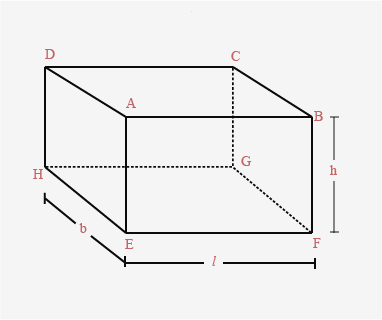
The total surface area of the cuboid(TSA) = Sum of the areas of all its six faces
TSA (cuboid) = 2(l×b)+2(b×h)+2(l×h)=2(lb+bh+lh)
Lateral surface area (LSA) is the area of all the sides apart from the top and bottom faces.
The lateral surface area of the cuboid = Area of face AEHD + Area of face BFGC + Area of face ABFE + Area of face DHGC
LSA (cuboid) = 2(b×h)+2(l×h)=2h(l+b)
Length of diagonal of a cuboid =√(l2+b2+h2)
Cube and its Surface Area
For a cube length = breadth = height

TSA (cube) =2×(3l2)=6l2
Similarly, the Lateral surface area of cube =2(l×l+l×l)=4l2
Note: Diagonal of a cube =√3l
Cylinder and its Surface Area
Take a cylinder of base radius r and height h units. The curved surface of this cylinder, if opened along the diameter (d = 2r) of the circular base can be transformed into a rectangle of length 2πr and height h units. Thus,
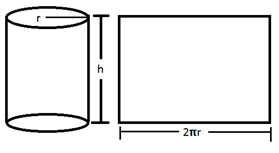
CSA of a cylinder of base radius r and height h=2π×r×h
TSA of a cylinder of base radius r and height h=2π×r×h + area of two circular bases
=2π×r×h+2πr2
=2πr(h+r)
Right Circular Cone and its Surface Area
Consider a right circular cone with slant length l, radius r and height h.
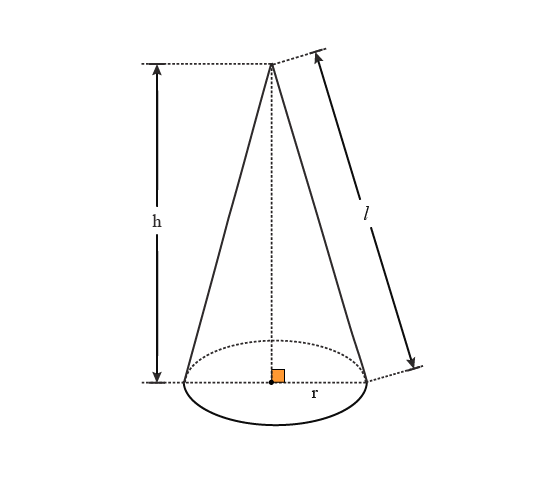
CSA of right circular cone =πrl
TSA = CSA + area of base =πrl+πr2=πr(l+r)
Sphere and its Surface Area
For a sphere of radius r
Curved Surface Area (CSA) = Total Surface Area (TSA) = 4πr2

Volume of a Cuboid
Volume of a cuboid =(base area)×height=(lb)h=lbh
Volume of a Cube
Volume of a cube = base area×height
Since all dimensions of a cube are identical, volume = l3
Where l is the length of the edge of the cube.
Volume of a Cylinder
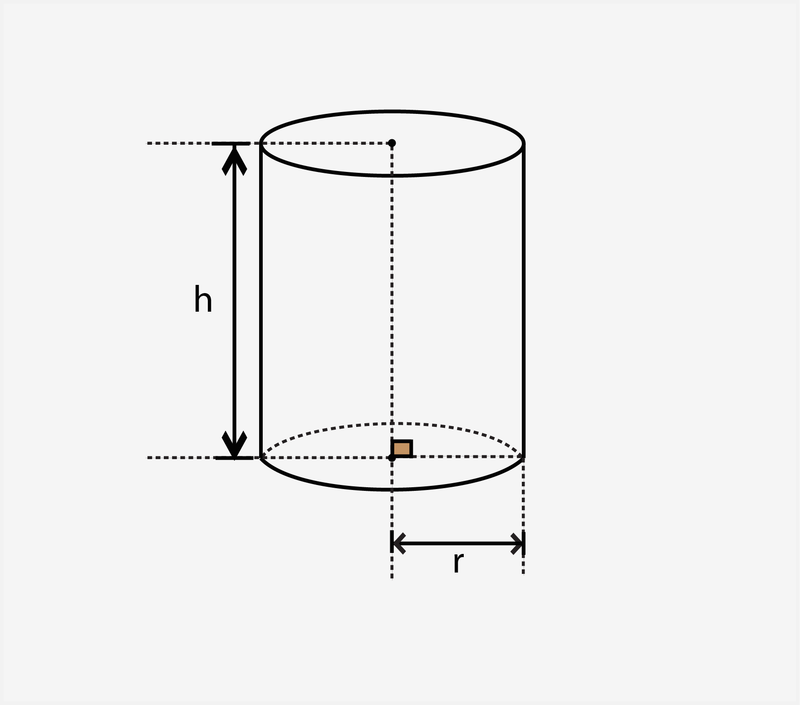
Volume of a cylinder = Base area × its height = (π×r2)×h=πr2h
Volume of a Right Circular Cone
The volume of a Right circular cone is 1/3 times that of a cylinder of same height and base.
In other words, 3 cones make a cylinder of the same height and base.
The volume of a Right circular cone =(1/3)πr2h
Where r is the radius of the cone and h is the height of the cone.
The volume of a Sphere
The volume of a sphere of radius r =(4/3)πr3
Hemisphere and its Surface Area
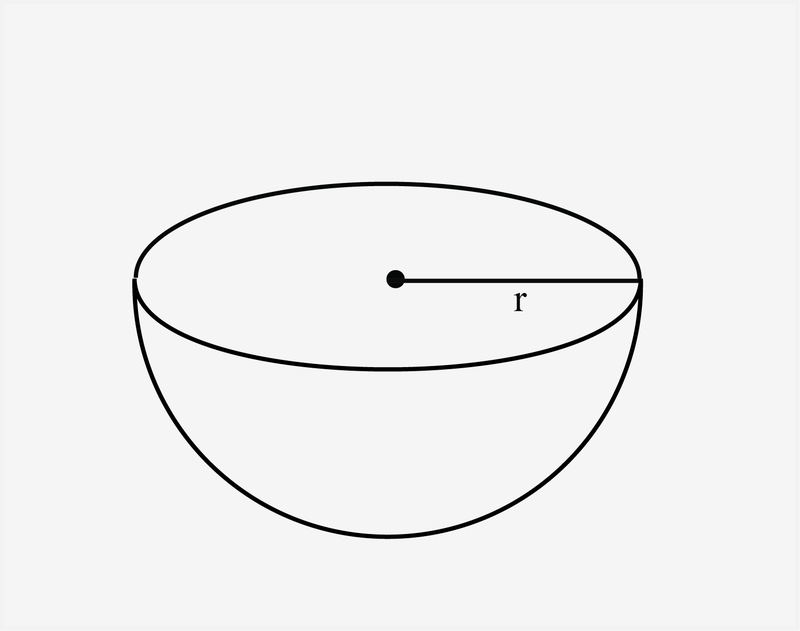
We know that the CSA of a sphere =4πr2. A hemisphere is half of a sphere.
∴ CSA of a hemisphere of radius r =2πr2
Total Surface Area = curved surface area + area of the base circle
⇒TSA =3πr2
Volume of Hemisphere
The volume (V) of a hemisphere will be half of that of a sphere.
∴ The volume of the hemisphere of radius r =(2/3)πr3
Combination of Solids
Surface Area of Combined Figures
Areas of complex figures can be broken down and analysed as simpler known shapes. By finding the areas of these known shapes we can find out the required area of the unknown figure.
Example: 2 cubes each of volume 64 cm3 are joined end to end. Find the surface area of the resulting cuboid.
Length of each cube =64(1/3)=4cm
Since these cubes are joined adjacently, they form a cuboid whose length l = 8cm. But height and breadth will remain same = 4cm.
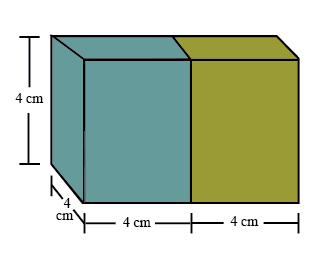
∴ The new surface area, TSA = 2(lb+bh+lh)
TSA = 2 (8×4 + 4×4 + 8×4)
= 2(32 +16+32)
= 2 (80)
TSA = 160cm2
Volume of Combined Solids
The volume of complex objects can be simplified by visualising it as a combination of shapes of known solids.
Example: A solid is in the shape of a cone standing on a hemisphere with both their radii being equal to 1 cm and the height of the cone is equal to its radius.
The above figure can be visualised as follows :
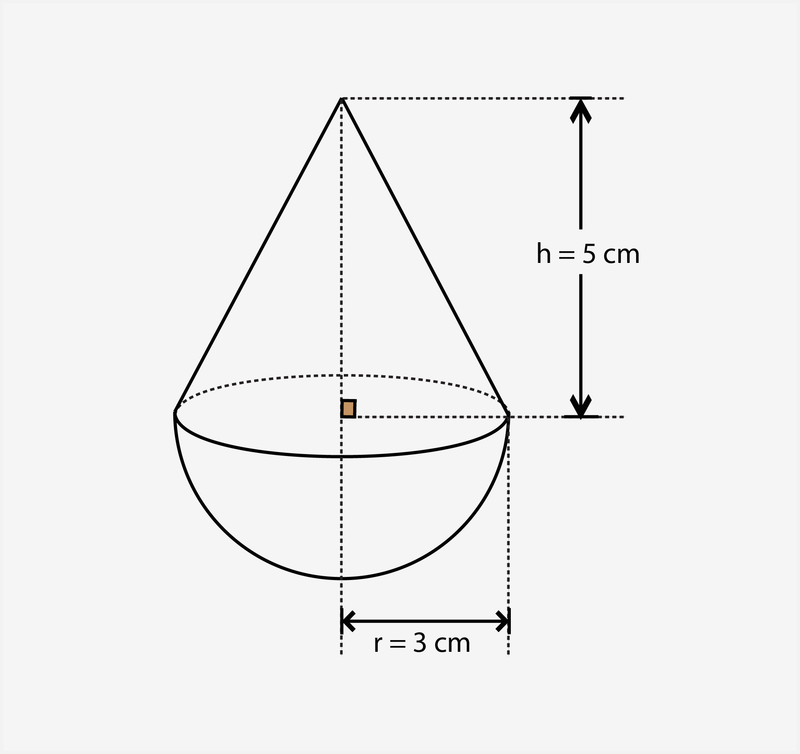
V(solid) = V(Cone) + V(hemisphere)
V(solid) = (1/3)πr2h+ (2/3)πr3
V(solid) = (1/3)π(9)(5)+ (2/3)π(27)
V(solid) =33π cm3
Shape Conversion of Solids
Frustum of a Cone
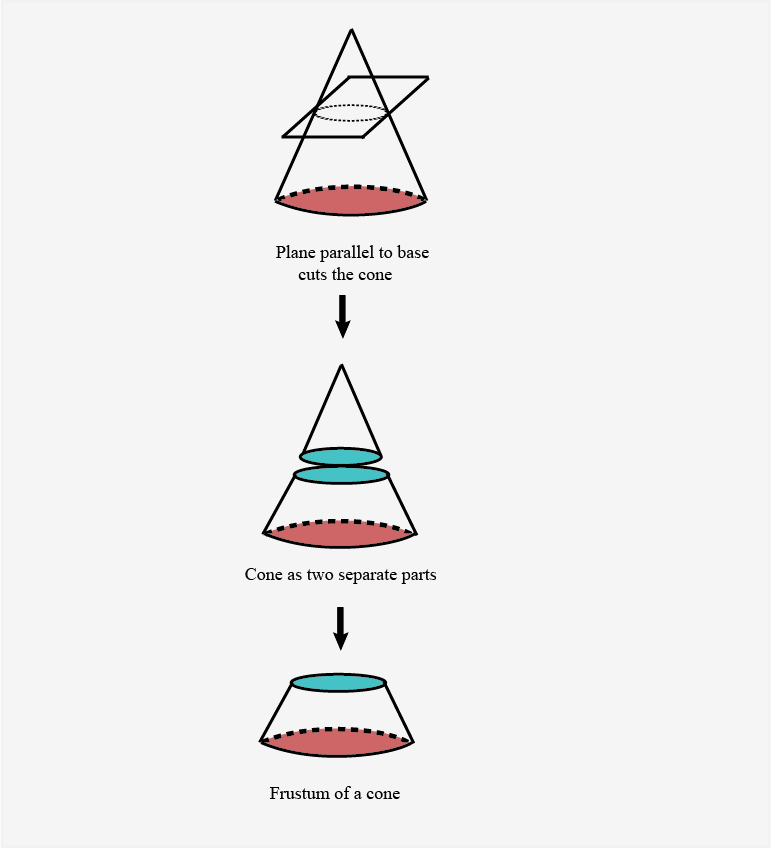
If a right circular cone is sliced by a plane parallel to its base then the part with the two circular bases is called a Frustum.
Surface Area of a Frustum
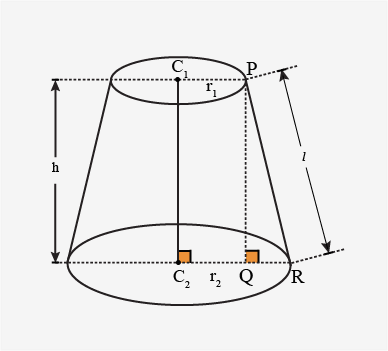
CSA of frustum =π(r1+r2)l, where l= √[h2+(r1+r2)2]
TSA of the frustum is the CSA + the areas of the two circular faces = π(r1+r2)l+π(r21+r22)
Volume of a Frustum
The volume of a frustum of a cone =(1/3)πh(r21+r22+r1r2)
Shape Conversion of Solids
When a solid is converted into another solid of a different shape(by melting or casting), the volume remains constant.
Suppose a metallic sphere of radius 9 cm is melted and recast into the shape of a cylinder of radius 6 cm. Since the volume remains the same after a recast, therefore the volume of the cylinder will be equal to the volume of the sphere.
The radius of the cylinder is known however the height is not known. Let h be the height of the cylinder.
r1 and r2 be the radius of the sphere and cylinder respectively. Then,
V(sphere) = V(cylinder)
⇒43πr31=πr22h
⇒43π(93)=π(62)h (On substituting the values)
⇒h=27cm
Comments
Post a Comment